
Introduction
Caris MI Tumor Seek Hybrid™ is innovative laboratory-developed test (LDT) that delivers comprehensive molecular profiling from tumour tissue samples. Unlike traditional Next-Generation Sequencing (NGS) methods that require separate DNA and RNA analysis processes, MI Tumor Seek Hybrid™ combines Whole Exome Sequencing (WES) and Whole Transcriptome Sequencing (WTD) of 23,000+ genes into one single assay. This integration provides a detailed molecular framework while preserving tissue.
Caris MI Profile™ platform offers AI solutions such as Caris GPsai™ and Caris FOLFIRSTai™ to guide clinicians in diagnoses and treatment of cancer patients.
- GPSai™ is an AI-predictive algorithm cancer type similarity assessment functionality and is performed for Cancer of Unknown Primary (CUP) cases. It helps identify the tumour of origin by comparing molecular characteristics of patient’s tumour against 90 tumour categories in the Caris database with an accuracy of 94.8%.
- Caris FOLFIRSTai™ is a chemotherapy response predictor intended to gauge a metastatic colorectal cancer (mCRC) patient’s likelihood of benefit from first line FOLFOX+BV followed by FOLFIRI+BV, versus FOLFIRI+BV followed by FOLFOX+BV treatment.
Caris MI Profile™ offers a ‘’Look back’’ programme, that builds on the promise of personalised medicine by alerting ordering clinicians when a new drug or indication is approved that may provide previously profiled patients with a new treatment option(s).


Technical information
The analysis covers DNA (SNVs, InDels, CNAs, viruses), RNA (gene fusions, expression, variant transcripts), using NGS. With whole exome (DNA) and transcriptome (RNA) sequencing, we analyze 23,000+ genes (1500x depth) and 17M RNA reads. We detect key alterations (e.g., fusions, CNAs) and genomic signatures (HRD, MSI, TMB). Clinical AI tools (Caris FOLFIRSTai™, GPSai™) and virus testing (HPV, EBV, MCPyV) enhance precision. Specimen requirements: 20% tumour (10 slides NGS only or 25 slides NGS+IHC).
| Technical Information | NGS (Whole Exome - DNA) | NGS (Whole Transcriptome - RNA) | |
|---|---|---|---|
| Sample Requirements | FFPE block or 10 unstained slides with a minimum of 20% malignant origin for DNA and 10% malignant origin for RNA. Needle biopsy is also acceptable (4-6 cores). | ||
| Tumour Enrichment (when necessary) | Microdissection to isolate and increase the number of cancer cells to improve test performance and increase the chance for successful testing from small tumor samples | ||
| Number of Genes | ~22,000 genes | ~22,000 genes | |
| Average Depth of Coverage (DNA) Average Read Count (RNA) | 500x for 700+ clinical and research genes and 200x for all other genes | 60 million | |
| Positive Percent Agreement (PPA) | > 95% for base substitutions at ≥ 5% mutant allele frequency; > 99% for indels at ≥ 5% mutant allele frequency; >95% for copy number alterations (amplifications ≥ 6 copies) | >97% | |
| Negative Percent Agreement (NPA) | >99% | >99% | |
| Genomic Signatures | Microsatellite Instability (MSI) Tumour Mutational Burden (TMB)* Loss of Heterozygosity (LOH)* MI FOLFOXai™ * – AI predictor of FOLFOX response in metastatic colorectal adenocarcinoma | – | |
| Genomic Signatures | MI GPSai™ * Genomic Prevalence Score – CUP, atypical presentation or clinical ambiguity cases | ||
Why Choose MI Tumor Seek Hybrid™?
1. Hybrid approach:
The integration of dual DNA and RNA sequencing in on assay allows simultaneous evaluation of genomic (DNA) and transcriptomic (RNA) alterations.
2. Extensive molecular coverage:
Comprehensive sequencing of over +23,000 genes through Whole Exome and Whole Transcriptome Sequencing (WES & WTS)
3. Advanced AI predictive algorithms:
Caris GPsai™ and Caris FOLFIRSTai™ use AI-driven predictive algorithms to support CUP diagnosis and predict response to FOLFIRI-based chemotherapy in mCRC patients.
4. Look back’ programme:
The Caris MI Profile™ “Look Back” programme alerts clinicians when new drug approvals or indications offer previously profiled patients potential new treatment options.
5. Therapy selection:
Detects targetable mutations, immunotherapy markers, resistance mechanism beneficial for therapy selection.
Applications
MI Tumor Seek Hybrid™ is ideal for:
- Therapy selection: Finding treatments that are suited to a patient’s tumour characteristics
- Clinical trial matching: Using biomarker information to match individuals with suitable clinical studies.
- Resistance mechanism analysis: Identifying treatments that are likely to be ineffective.
- Cancer subtyping: Improving diagnostic accuracy and prognostic assessment.
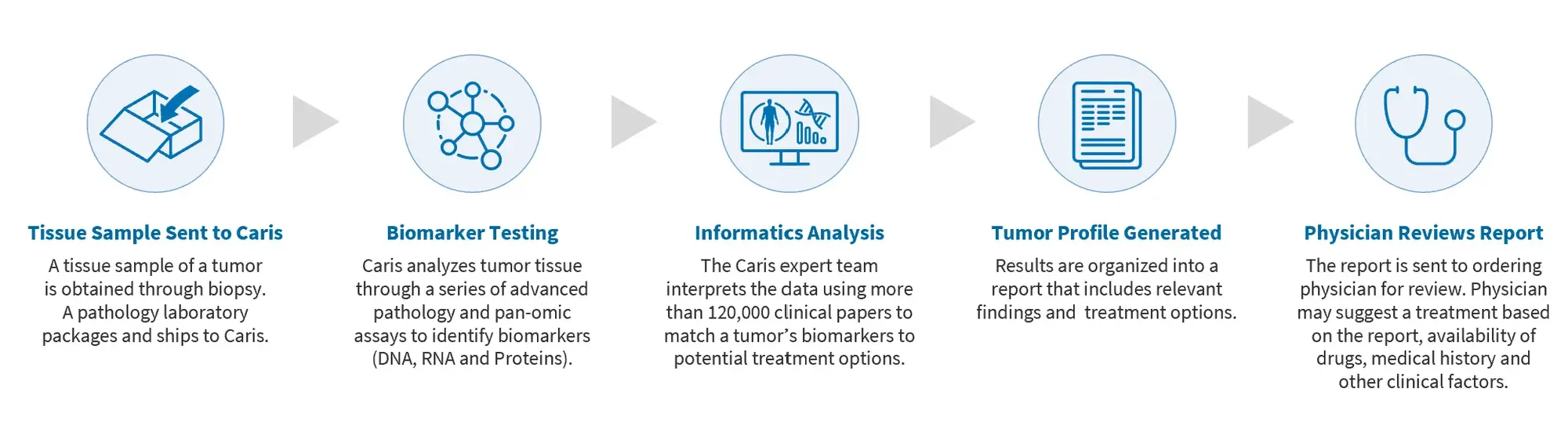
How does MI Tumor Seek Hybrid™ work?
Caris MI Profile™ platform combines comprehensive molecular profiling of DNA, RNA, with advanced bioinformatics, providing clinicians with valuable insights to determine the most effective treatments, predicts resistance mechanisms, and tailor personalised treatment approaches for patients:
Research and Publications:
Explore Caris Life Sciences’ latest research and clinical publications on precision oncology, molecular profiling and liquid biopsy by visiting Caris Life Sciences’ publications library.
