
Overview
M371 is a molecular diagnostic assay for the identification and surveillance of testicular germ cell tumours (type II germ cell neoplasia in situ-derived testicular germ cell tumour, or GCNis-derived TGCT). Using microRNA biomarker technology, M371-Test provides sensitive and specific results, as demonstrated in clinical studies, to support earlier diagnosis and follow-up management.
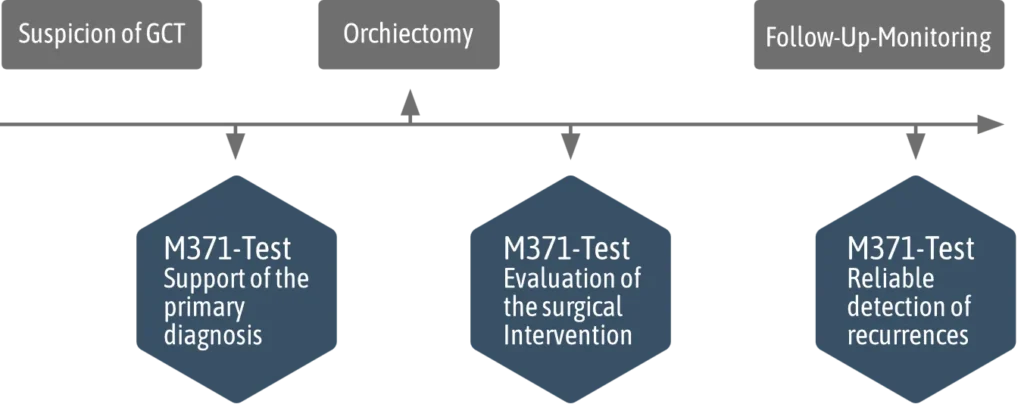
Key Features of M371-Test
Sensitivity and specificity
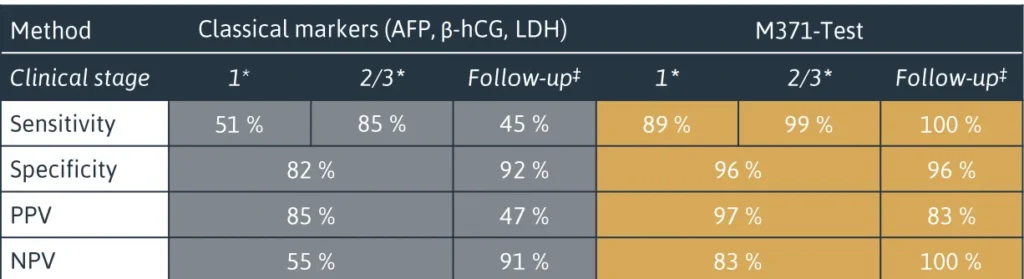
M371 has demonstrated higher sensitivity and specificity for detecting testicular germ cell tumours than classical tumour markers (AFP, β-hCG, LDH) alone.
Non-invasive testing
A standard blood sample replaces the need for more invasive procedures.
Turnaround time
Results support timely diagnosis and intervention within established clinical pathways.
Monitoring over time
Supports tracking of disease progression, recurrence and treatment response, informing patient management alongside clinical assessment.
Who Should Use M371-Test?
- Oncologists and urologists managing patients with known or suspected testicular germ cell tumours
- Clinicians requiring additional diagnostic information alongside classical serum markers
- Use in follow-up surveillance, including monitoring for up to 10 years per clinical guidelines
How M371-Test Works
M371 is a non-automated assay with a qualitative interpretation of results, detecting testicular germ cell tumours (GCNis-derived TGCT) using microRNA biomarker technology. It is intended for use in both diagnosis and follow-up monitoring.
- Sample collection: a blood sample is taken from the patient
- Analysis: the sample is analysed using qPCR
- Results: a detailed report is provided to support clinical decision-making
Clinical Validation and Research
M371 has been validated across multiple clinical studies:
- Sensitivity – primary diagnosis: 89% (clinical stage I), 99% (clinical stage II/III); follow-up: 100%
- Specificity – primary diagnosis: 96%; follow-up: 96%
- Tumour burden and treatment response correlate with miR-371a-3p expression levels
- In patients without metastases, miR-371a-3p drops to 2.6% of the pre-operative value within 24 hours of orchiectomy, enabling faster staging
- miR-371a-3p is not detectable in other tumour types or testicular conditions, supporting its specificity as a germ cell tumour biomarker
- Recurrences are detected reliably, with potential to reduce reliance on CT scans in follow-up care, lowering radiation exposure in a predominantly young patient group
LDH was not considered in the follow-up setting (Belge et al., 2024). Sensitivity for primary diagnosis is reported separately for clinical stage I versus stages II and III.
M371-Test and TC100
M371 is also available as part of TC100, EDX Medical’s combined testicular cancer testing pathway, which pairs M371 with classical serum markers (AFP, β-hCG, LDH) for full-spectrum diagnosis and follow-up.
Availability Through EDX Medical
M371-Test is available in the UK through EDX Medical. For ordering information, turnaround times, and pathway integration, please contact EDX Medical.
